
Quick answer
- The golden rule: be at traffic speed by the end of the ramp. Slow merges cause most of the danger.
- Pick your gap early, halfway down the ramp, not at the end of it.
- One mirror glance is not enough: shoulder check just before you move across the line.
- Merging traffic yields. You are joining their road, but most drivers will cooperate if your speed makes it easy.
- Never stop on a live ramp unless the traffic ahead of you already has.
Ask new drivers what scares them most and merging wins by a landslide. That fear is rational: you are joining traffic moving 100 km/h or more with a finite piece of asphalt to do it on. It is also very fixable, because bad merges almost always come from the same two or three errors. This guide walks the manoeuvre step by step, the way we teach it on highway lessons around Chilliwack.
Why merging feels hard
A merge stacks three tasks that new drivers usually handle one at a time: accelerating hard, judging the speed and spacing of traffic behind you, and steering a smooth path, all inside ten or fifteen seconds. Under pressure, most people drop the first task and enter too slow. That single mistake creates almost every frightening merge, because a car doing 70 in a 100 km/h flow turns every gap into a moving wall.
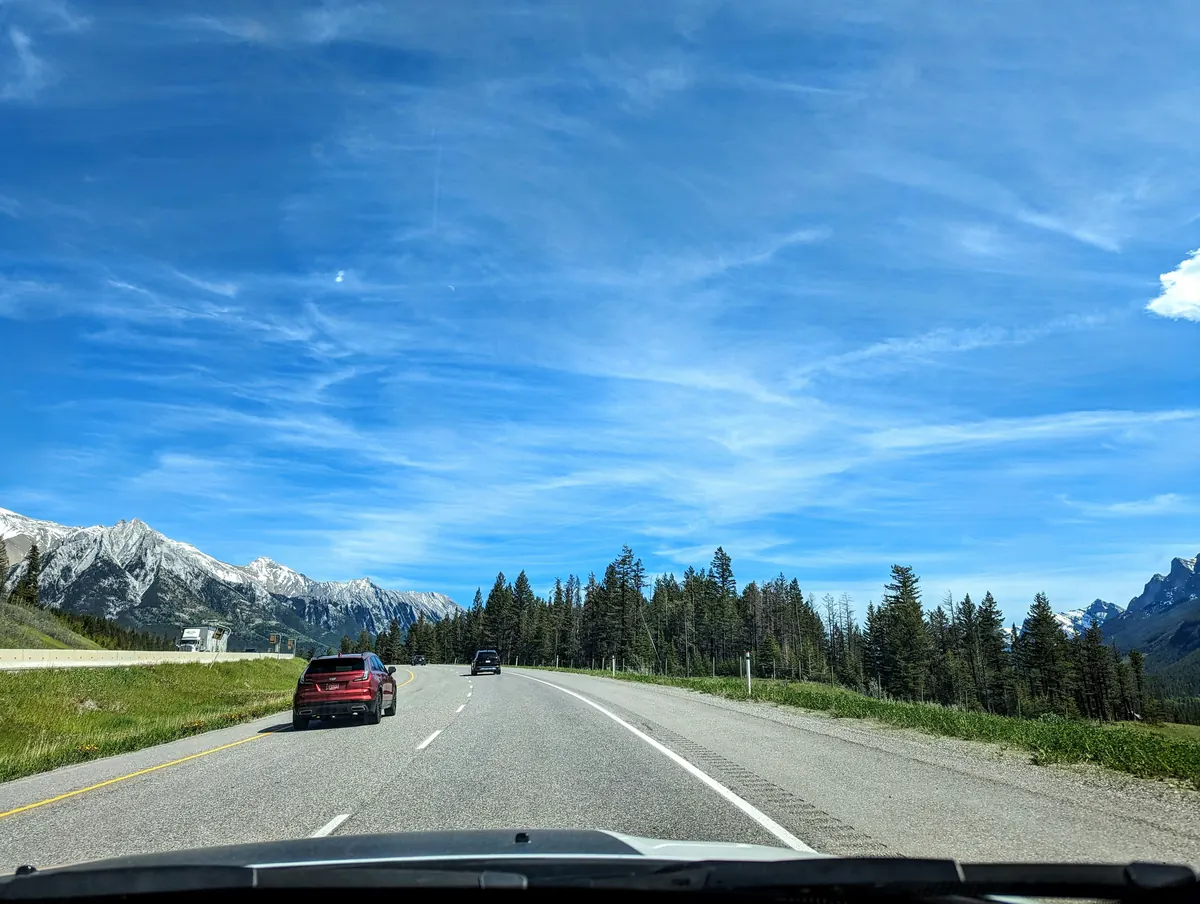
The merge, step by step
- On the ramp: signal and build speed.
Signal early, then commit to acceleration. The ramp exists for one purpose: to get you to highway speed before you arrive. - Read the traffic while accelerating.
Quick mirror glances plus what you see ahead. You are answering one question: where is my gap going to be when I get there? - Adjust with throttle, not brakes.
A little more speed puts you ahead of a cluster; easing off drops you behind it. Small, early adjustments beat big, late ones. - Shoulder check, then move.
Just before crossing the line, one decisive shoulder check for the blind spot your mirrors cannot see. - Blend in and rebuild your gap.
Cancel the signal, settle into the lane, and re-open a 3-second following distance before you relax.
The mistakes that cause scary merges
Merging 30 under
The classic. Entering at 70 into a 100 km/h flow forces everyone else to solve the problem you created. Fix: use the whole ramp to accelerate.
Stopping at the ramp end
Unless traffic ahead of you is stopped, a stop turns a merge into a standing start into 100 km/h traffic, which is the hardest manoeuvre in driving. Keep rolling, keep building speed.
Mirror fixation
Staring at the mirror while the ramp curves away from under you. The rhythm is simple: ahead, mirror, ahead, shoulder, go.
Forcing a half-gap
If the gap needs the other driver to brake hard, it was not your gap. Adjust speed and take the next one. It is only seconds away.
Instructor tip
If a merge went badly, the error usually happened five seconds earlier, back on the ramp, at the moment you settled for less speed. Fix the beginning and the end fixes itself.
What highway traffic expects from you
Legally, entering traffic yields: the vehicles already on the highway have the right of way, and BC’s Learn to Drive Smart guide is explicit that merging drivers must adjust to the flow, not the other way around. In practice, most BC drivers will help by moving over a lane or easing off when your speed makes cooperation cheap. Arrive at flow speed with a clear signal and you will find that “aggressive Highway 1 traffic” is mostly a myth told by slow mergers.
Practising merges around Chilliwack
Chilliwack is a genuinely good town to learn merging: Highway 1 runs through it with a string of full interchanges (Lickman Road, Evans Road, Vedder Road, Prest Road, Annis Road), so you can run ramp-to-ramp circuits and stack many merges into a single session. Mid-morning on a weekday, the flow is steady but forgiving.
That is exactly how we structure it in a lesson: several supervised merges in a row in a dual-control car, starting at quiet hours, moving up as they get boring. One focused Core Session is usually enough to turn merging from gambling into procedure. And if your Class 5 road test is coming, the examiner may watch you do exactly this on Highway 1.
FAQ
Do I have the right of way when merging onto a highway?
No. Vehicles already on the highway have the right of way, and the merging driver is required to adjust speed and position to join safely. Courteous drivers often move over or ease off, but you cannot rely on it. Plan the merge as if nobody will help, and be pleasantly surprised when they do.
What if the acceleration lane ends before I find a gap?
This almost always means the speed decision came too late. If it happens: stay calm, use every remaining metre while adjusting speed to the nearest gap, slightly faster or slower, and merge decisively. Slowing hard should be the last resort, and stopping is only for when traffic ahead of you on the ramp has stopped.
Should I stop at the end of the ramp if traffic is heavy?
Only if the vehicles ahead of you are stopped. A voluntary stop on a live ramp creates a standing start into highway-speed traffic, which is far more dangerous than a slow rolling merge. In genuinely stop-and-go congestion, merges happen at low speed and work like a zipper.
Related Road Test Guides
Official resources
Use this guide as a practical explanation. For official licensing, appointment, and road test information, always check ICBC directly.
This article is written by Right of Way Driving School for students preparing in Chilliwack and the Fraser Valley. It is educational content and is not an official ICBC publication.
Ten supervised merges beat a hundred lucky ones.
Book a lesson, tell us merging is the goal, and we will build a ramp-to-ramp route on Highway 1 in a dual-control car, where an error is just a teaching moment.