Quick answer
- A painted line does not answer the legal question by itself. The manoeuvre decides which rule applies.
- You may turn left across a double solid yellow line to enter or leave a highway. Sections 151 and 155 are suspended while you do it (Motor Vehicle Act, s.156).
- You may pass over a single solid yellow line. The Act treats a single line the same whether broken or solid (s.155(1)(c)).
- You may not pass over a double solid line, and the obstruction exception does not cover it either (s.155(2)).
- Since June 2024 you may cross a line, including a double solid, to give a cyclist or pedestrian the required space (s.157.1(3)).
- Signs beat paint. A No Left Turn or Do Not Pass sign applies "despite anything in this Act" (s.161).
- No stopping within 5 m of a hydrant, 6 m before a crosswalk, 6 m before a stop sign or signal, 15 m of a railway rail (s.189).
Road markings are the part of the handbook everyone assumes they already understand. Then a real situation arrives: a stalled car in your lane, a driveway on the far side of a double yellow, a cyclist to get around on a narrow road in Sardis. The paint suddenly does not seem to answer the question, and the reason is simple. It never did.
Here is every marking you will meet on a BC road, what the Motor Vehicle Act actually says about it, and where the common beliefs go wrong.
Does the painted line decide what you are allowed to do?
No. The line is one input. Crossing a line is a physical act, not a legal category of its own. The Act deals in situations, and six of them cover almost everything a driver does.
Passing
Overtaking and returning to your lane. The line rules in s.155, plus s.157 to s.160.
Changing lanes
Moving between marked lanes running the same direction. Section 151.
Entering or leaving a highway
Turning into a driveway or out of one. Section 156 suspends s.151 and s.155 while you do it.
Avoiding an obstruction
A narrow exception in s.155(2) that does not apply to every line.
Passing a vulnerable road user
Since June 2024, s.157.1 lets you cross lines to give a cyclist or pedestrian legal space.
Turning around
A U-turn has its own section, s.168, and the line rules do not help you at all.
The same double yellow line can be legal to cross in situation 3 and illegal to cross in situation 1. That is not a loophole. It is how the Act is built.
About colours
The words "yellow" and "white" do not appear in these sections. Section 151 applies to a "laned roadway", defined as a roadway divided into two or more marked lanes "for the movement of vehicular traffic in the same direction" (s.119(1)). Section 155 applies to your position relative to lines. In typical BC marking practice white lines separate same-direction traffic and yellow centre lines separate opposing directions, so the two usually line up. But the applicable rule is set by the road layout and the manoeuvre, not by the colour.
What do the yellow lines down the middle of the road mean?
Section 155(1) opens with three words that matter: "Despite anything in this Part".
Broken yellow line
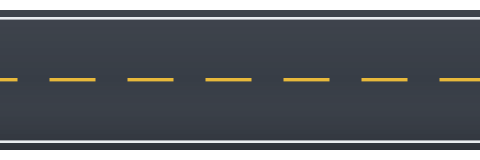
A single broken line falls under the same paragraph as a single solid line: "one single line, broken or solid, the driver of a vehicle must drive the vehicle to the right of the line, except only when passing an overtaken vehicle" (s.155(1)(c)). You may cross to pass, if you can do it safely (s.159) with a clear view for a safe distance (s.160). A broken line means passing is permitted. It says nothing about the truck coming the other way.
Single solid yellow line
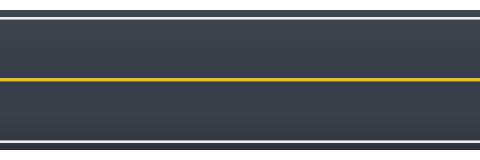
This is the one that surprises people. It has its own section below.
Double solid yellow line
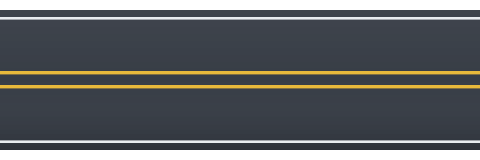
Short, with no exception inside it: "a solid double line, the driver of a vehicle must drive it to the right of the line only" (s.155(1)(a)). Note the word "only". Within s.155 there is no exception for turning and none for obstructions. The exceptions that exist live in other sections.
One solid line and one broken line together
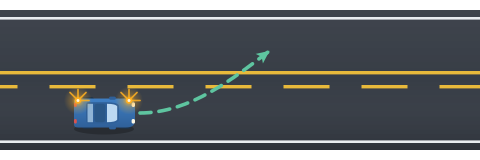
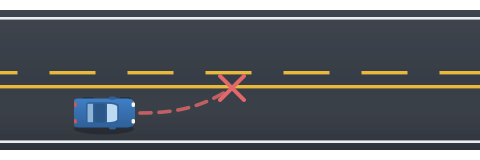
This pair is asymmetric, and the whole difference sits in two words. On the broken side you keep right of the double line "except when passing an overtaken vehicle" (s.155(1)(b)(i)). On the solid side, "except only when finishing the passing of an overtaken vehicle" (s.155(1)(b)(ii)).
So from the solid side you may not begin a pass. If you were already alongside when the marking changed, the Act lets you complete the manoeuvre rather than forcing you back in.
Double broken yellow lines
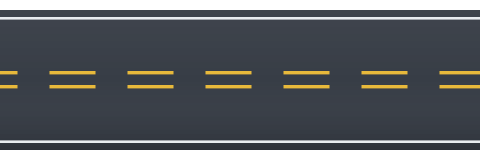
Two broken yellow lines around a lane mean the lane is reversible: the direction of travel changes through the day and overhead signals decide who may use it. A green arrow means it is open to you. A red X means it is not, and driving in it disobeys a traffic control device (s.161(a)).
What do white lines mean, and why is the rule different?
White lines usually separate lanes moving the same direction, which puts you in section 151 rather than section 155.
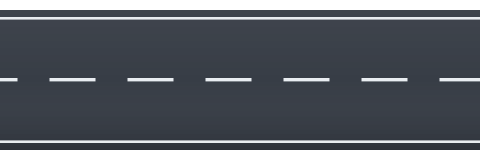
Broken white line. Where "a broken line only exists between the lanes", a driver must not change lanes "unless the driver has ascertained that movement can be made with safety and will in no way affect the travel of another vehicle" (s.151(a)). Not "unreasonably affect". In no way. If the driver behind has to lift off the accelerator, the standard has not been met. You must also signal (s.151(c)).
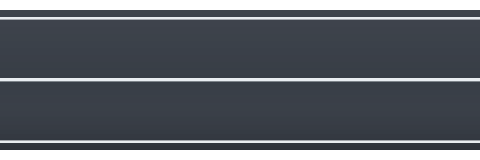
Solid white line. A driver "must not drive it from one lane to another if that action necessitates crossing a solid line" (s.151(b)). That is why the paint goes solid before intersections and alongside HOV and bike lanes. It prohibits the lane change, not every possible movement, because s.156 can suspend s.151 when you are entering or leaving the highway.
Edge lines. The line along the right edge marks where the lane ends and the shoulder begins. It is a guide, not a lane. Using the shoulder to get past slow traffic is passing on the right outside the permitted circumstances (s.158), and on rural roads around Chilliwack the shoulder is where people walk and ride.
Can you turn left across a double solid yellow line in BC?
Yes, when you are entering or leaving a highway, you can do it safely, and no sign prohibits it. The mechanism is section 156:
"If the driver of a vehicle is causing the vehicle to enter or leave a highway and the driver has ascertained that the driver might do so with safety and does so without unreasonably affecting the travel of another vehicle, the provisions of sections 151 and 155 are suspended with respect to the driver while the vehicle is entering or leaving the highway."
"Suspended" is a strong word. The section does not excuse a breach of s.155, it switches s.155 off for the duration of the manoeuvre. It also does not require the driveway itself to be a highway. It applies because you are leaving the highway you are on, or joining it.
ICBC says the same in Learn to Drive Smart, chapter 4: "You may turn left, including turning left over a solid double yellow line, if you do this carefully and safely and don't impede other traffic, and there are no signs prohibiting such turns." Most drivers believe the opposite because ICBC sets out the general rule and the exception in different chapters, fourteen pages apart, without linking them.
What "without unreasonably affecting" asks of you
This is broader than physically blocking a lane, and it is a judgment call: how long traffic behind you will sit, how fast the flow is, whether drivers can see you in time. A turn that makes a queue brake hard on Yale Road is a different thing from the same turn on a quiet street. If there is no safe gap and waiting will hold up traffic, carry on and come back another way.
What the courts have said
- Mills v. Seifred, 2009 BCSC 447, upheld 2010 BCCA 404. A truck turned left across a double solid line into a mill yard and a motorcyclist died. This was a civil negligence case, not a ruling on a traffic ticket. The court did not say the turn was legal. It held that the line does not end the analysis, then assessed whether that turn met the s.156 standard and the general duty of care.
- Dhah v. Harris, 2010 BCSC 172. Often quoted for the phrase "absolute prohibition". The manoeuvre was a U-turn mid-block, with no intersection and no driveway. A U-turn is neither entering nor leaving a highway, so s.156 had nothing to suspend.
- Shallow v. Dyksterhuis, 2013 BCSC 1761. A left turn onto an access road, which the judge described as a lawful left turn, treating the double line as a prohibition on passing.
These are sometimes presented as contradicting each other. They do not. They describe different manoeuvres in different places, and together they show one thing: what matters is the purpose of crossing the line and whether s.156 applies to it.
Legal, safe and ticket-free are three different things
A turn can be permitted by s.156 and still leave you carrying the responsibility if a collision happens. The word "unreasonably" is not defined in the Act. Treat the turn as a decision, not an entitlement.
What does section 156 not suspend?
Section 156 suspends sections 151 and 155. Nothing else.
Signs win
"Despite anything in this Act", a device prohibiting a movement prohibits it. A No Left Turn sign ends the discussion.
Raised medians
Where a highway is divided by "a physical barrier or clearly indicated dividing section", cross only at a crossover or intersection. No s.156 relief.
Left turns away from an intersection
Approach nearest the centre line, be in that position, and ascertain the movement is safe. A separate offence with its own fine.
U-turn limits
Turning around has its own restrictions, and s.156 does not touch them.
Leaving a driveway
In a business or residence district, stop before the sidewalk and yield to pedestrians on it, then yield to traffic.
Due care
Driving without due care and attention remains an offence whichever line you crossed.
Your duty to signal and to yield to oncoming traffic also survive untouched, and the suspension lasts only for the manoeuvre. It is not permission to drive along on the wrong side of the line.
Can you pass over a single solid yellow line in BC?
Yes. This is genuinely different from most of North America, and it catches out drivers who learned in the United States or who practise with American apps.
"one single line, broken or solid, the driver of a vehicle must drive the vehicle to the right of the line, except only when passing an overtaken vehicle" (Motor Vehicle Act, s.155(1)(c))
The Act makes no distinction between a single broken line and a single solid line. What still restricts you is everything around it: you may not pass unless you can do so in safety (s.159), you need a clear view for a safe distance (s.160), a Do Not Pass sign overrides the line completely (s.161(b)), and you must pass at a safe distance and not return right until safely clear (s.157(1)).
In practice a single solid line is painted where sight lines are marginal. The Act permits the pass. The road is telling you it is a poor idea. Both are true at once.
Can you go around a stalled car or an obstruction?
Sometimes, and it depends on the line. The exception is deliberately narrow: "Subsection (1) (b) (i) and (c) do not apply if a driver is avoiding an obstruction on the highway and first ascertains that the movement can be made with safety and without affecting the travel of any other vehicle" (s.155(2)). Two paragraphs only.
| Line in front of you | May you cross it to avoid an obstruction? |
|---|---|
| Single line, broken or solid | Yes, s.155(2) covers s.155(1)(c) |
| Solid and broken, you are on the broken side | Yes, s.155(2) covers s.155(1)(b)(i) |
| Solid and broken, you are on the solid side | No, s.155(1)(b)(ii) is not listed |
| Double solid line | No, s.155(1)(a) is not listed |
Read strictly, the Act lets you steer around a stalled car across a single solid line but not across a double solid line. It is counterintuitive and it has sat in the statute for years. In a genuine emergency, safety and the direction of a peace officer come first. But do not carry around the belief that any obstruction lets you cross any line.
Can you cross the line to give a cyclist or pedestrian room?
Yes, and this is the newest rule here. Since 3 June 2024 you must not pass a cyclist or pedestrian unless it can be done safely and you can maintain "a minimum distance of 1 m", or the prescribed minimum distance where one applies, which is 1.5 m where the speed limit is above 50 km/h (s.157.1(1) and (2)).
Then comes the part almost nobody knows. A driver who takes an action that would otherwise contravene s.151(b), (f) or (g) or s.155(1) "does not contravene the provision" if it is done while passing in compliance with the section and the driver has ascertained it can be done safely "and without affecting the travel of another vehicle" (s.157.1(3)).
That includes the double solid line. It is one of only two ways past s.155(1)(a). Note the standard though: without affecting another vehicle, which is stricter than "unreasonably affecting" in s.156. If there is oncoming traffic, you wait behind the cyclist.
The most expensive line offence on this page
Failing to give a cyclist or pedestrian the required space carries a $368 fine and 3 penalty points. Every other line offence here is $109 or $121.
Where are U-turns allowed, and what counts as a business district?
A U-turn is not passing and it is not entering or leaving a highway, so neither the s.155 exceptions nor s.156 helps you. Section 168 applies regardless of the paint. Subject to municipal bylaws, a driver must not turn so as to proceed in the opposite direction:
- unless it can be done without interfering with other traffic (s.168(a));
- on a curve (s.168(b)(i));
- on an approach to or near the crest of a grade where the vehicle cannot be seen from either direction within 150 m (s.168(b)(ii));
- where a sign prohibits a U-turn (s.168(b)(iii));
- at an intersection with a traffic control signal (s.168(b)(iv));
- in a business district, except at an intersection with no signal (s.168(b)(v)).
Drivers treat "business district" as something you judge by eye. The Act defines it with a tape measure: "the territory contiguous to a portion of a highway having a length of 200 m along which there are buildings used for business, industrial or public purposes occupying (a) at least 100 m of frontage on one side of that portion, or (b) at least 100 m collectively on both sides" (s.119(1)).
Two things to hold on to. A broken centre line gives you no right to turn around; it is about passing. And municipalities may regulate U-turns by bylaw, including prohibiting them outright, so check the rules where you are driving.
How do you use a two-way left-turn lane?
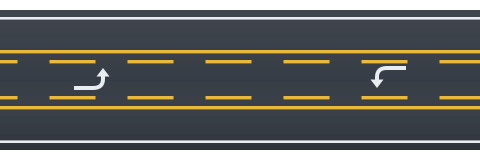
The Act does not give this lane its own section. It works through the general rules: the markings are a traffic control device (s.119(1)), you must obey them (s.161), and a left turn away from an intersection must satisfy s.166. Provincial marking practice and ICBC's Learn to Drive Smart both treat it as a turning lane only.
- Enter shortly before your turn, not several blocks early.
- Do not travel along it, pass in it, or use it to accelerate out of a business.
- Expect a vehicle facing you doing the same thing. That is why you enter late and keep your wheels straight.
- Turning left out of a driveway you may use it to complete your entry, but you must still yield.
Where can you enter an HOV or reserved lane?
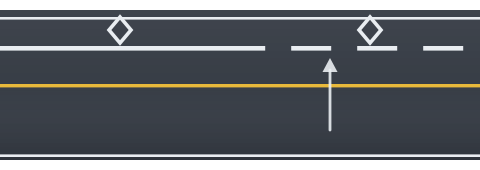
"If a laned roadway has a high occupancy vehicle lane, a person must not drive a motor vehicle or other device in that lane unless permitted by the regulations" (s.152). Bus lanes work the same way under s.153, and designated use lanes under s.153.2.
Here is the part drivers miss. Qualifying to use the lane does not tell you where to enter it. Where the line beside an HOV lane is solid, crossing it is a lane change over a solid line under s.151(b), a $109 fine and 2 penalty points, even with four people in the car. Enter and leave only where the line is broken.
What do bike lanes, green paint and sharrows mean for drivers?
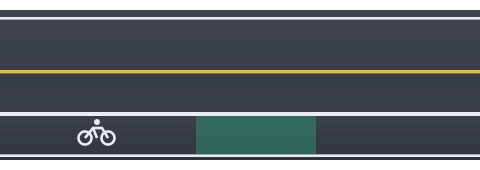
A cyclist on the road "has the same rights and duties as a driver of a vehicle" (s.183(1)), so treat a bike lane as you would any other lane.
Solid line beside a bike lane
Do not change lanes across it, and do not drive or wait in the lane. Where the line goes broken near an intersection, that is where the design expects paths to cross.
Green paint
Green surfacing marks a conflict area where cycling and driving paths cross. A warning to look, not permission for either side. Introduced through the BC Active Transportation Design Guide, 2019.
Sharrows
A bicycle with two chevrons marks a shared lane. It does not create a bike lane. It tells you cyclists belong there and where they will ride.
You may cross a bike lane's solid line to turn into a driveway, because that is leaving the highway and s.156 suspends s.151 while you do it. What it does not suspend is your obligation to look. Signal early, shoulder check, and let a cyclist beside you clear before you turn across their path.
Where exactly do you stop at a stop line or crosswalk?
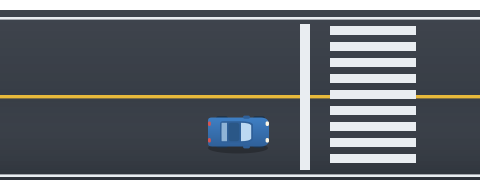
The Act gives the order, and it is worth memorising because examiners mark it: "if there is a stop sign at an intersection, a driver of a vehicle must stop (a) at the marked stop line, if any, (b) before entering the marked crosswalk on the near side of the intersection, or (c) when there is neither a marked crosswalk nor a stop line, before entering the intersection, at the point nearest the intersecting highway from which the driver has a view of approaching traffic" (s.186).
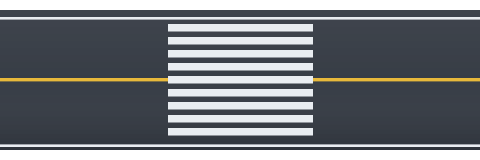
Two things catch people out. A crosswalk does not need paint to exist: the definition includes the portion of a highway at an intersection between the extended lateral lines of the sidewalks, marked or not (s.119(1)). Unmarked crosswalks exist at almost every intersection with sidewalks in Chilliwack. And when a vehicle is slowing or stopped at a crosswalk to let someone cross, a driver approaching from behind must not overtake and pass it (s.179(3)). That single rule prevents one of the worst collision types there is.
Can you drive over painted islands, gore areas and chevrons?
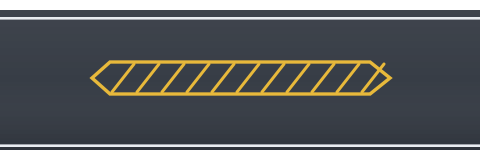
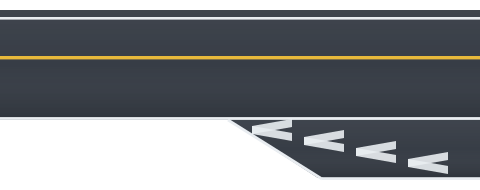
Diagonal hatching and chevrons mark space that is not meant for vehicles: they separate movements, protect a turning bay, or fill the wedge where a ramp splits away. They are traffic control devices and s.161 requires you to obey them. On a controlled access highway you may only enter or leave at the locations indicated by signs (s.164), which is exactly what people breach when they cut across the gore for a missed exit. Do not drive over them, straddle them, or sit in them waiting for a gap.
Paint is not a median
A painted island is markings. A raised curb, barrier or constructed dividing section is section 163, which has no exceptions at all: cross it only at a crossover or intersection. Calling a double yellow line a "median" is one of the most common mistakes in driving conversations, and it sends people to the wrong rule in both directions.
What do the arrows painted in your lane mean?
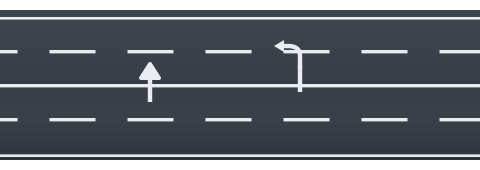
A painted arrow is an instruction. Where devices indicate the direction vehicles must proceed, "a person must not drive a vehicle other than in the direction indicated" (s.161(a)), and where a device indicates the course to be travelled by turning vehicles, a driver "must turn a vehicle at the intersection in the manner directed" (s.165(4)). A lane marked with a left arrow only is a left turn, not a left turn or straight, whichever suits. Section 151 also requires the correct lane on approach: nearest the centre for a left turn (s.151(d)), nearest the right for a right turn (s.151(e)).
What do the markings before a railway crossing mean?
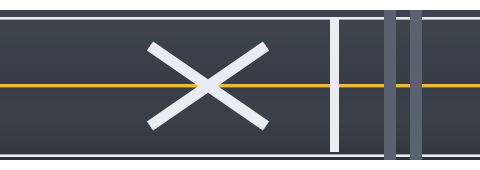
The large X on the road surface, usually with the letters R and X and a pair of transverse bars, is advance warning of a level crossing. Chilliwack and the wider Fraser Valley have plenty of them.
- Where signals are flashing, a gate is lowered, a flagger is signalling, or a train is within roughly 500 m or is otherwise an immediate hazard, stop within 15 m but not less than 5 m from the nearest rail (s.185(1)).
- Do not drive through, around or under a crossing gate while it is closed or moving (s.185(2)).
- Where a stop sign is erected at the crossing, stop no farther than 15 m from the nearest rail (s.185(3)).
- Once moving, do not shift gears and do not stop with any part of the vehicle on or over the tracks (s.185(5)).
- Do not stop, stand or park within 15 m of the nearest rail (s.189(1)(i)).
Where are you not allowed to stop or park in BC?
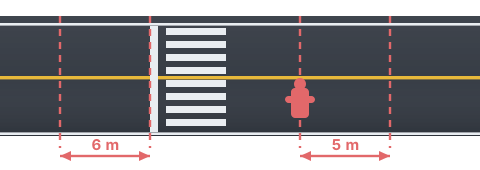
Section 189 applies everywhere in BC, sign or no sign. It opens: "Except when necessary to avoid conflict with traffic or to comply with the law or the directions of a peace officer or traffic control device, a person must not stop, stand or park a vehicle as follows" (s.189(1)).
| Distance | Where | Provision |
|---|---|---|
| 5 m | From a fire hydrant, measured from the point in the curb or edge of the roadway closest to the hydrant | s.189(1)(d) |
| 6 m | On the approach side of a crosswalk | s.189(1)(f) |
| 6 m | On the approach to a flashing beacon, stop sign or traffic control signal at the side of a roadway | s.189(1)(g) |
| 6 m | Either side of the entrance to or exit from a hotel, theatre, public meeting place, dance hall, fire hall or playground in a rural area | s.189(1)(h) |
| 15 m | From the nearest rail of a railway crossing | s.189(1)(i) |
And the places with no distance attached, where the answer is simply no:
- On a sidewalk or boulevard (a), and on a crosswalk (e).
- In front of a public or private driveway (b), including your own.
- In an intersection, except as permitted by a sign (c).
- On a highway mainly to display a vehicle for sale, to advertise, grease, paint, wreck, store or repair a vehicle unless repairs are needed because of an emergency, to display signs, or to sell flowers, fruit, vegetables, sea foods or other commodities (j).
- Alongside or opposite a street excavation or obstruction when it obstructs traffic (k).
- On the roadway side of a vehicle already parked at the curb, which is double parking (l).
- On a bridge or other elevated structure, or in a highway tunnel, except as permitted by a traffic control device (m).
- Anywhere a traffic control device gives notice that stopping, standing or parking is prohibited or restricted (n).
- In a manner that obstructs the visibility of a standard traffic sign (o).
Two more sections finish the picture. Outside a business or residence district, if it is practicable to stop off the roadway you must not leave the vehicle on it, and you must never park so as to obstruct the free passage of traffic (s.187). And you must park on the right side, parallel to the roadway, within 30 cm of the curb where there is one (s.190).
Bus stops are not in section 189
People often quote a distance for bus stops. Section 189 does not mention them. Bus stops are controlled by signs, painted curbs and municipal bylaws, and the defined length of a stop varies between communities. If you cannot see where the stop begins and ends, park somewhere you are certain about.
Section 189 is also why "I was only stopping for a second" does not work. It prohibits stopping, standing and parking alike. Stopping means the wheels have stopped turning. If you are stopped in one of these places at all, you are in it.
What do these tickets cost, and how many points?
Amounts below are from the Violation Ticket Administration and Fines Regulation and ICBC's published fines list, checked in August 2026. The second figure is the early payment amount. Penalty points come from Division 28 of the Motor Vehicle Act Regulations.
| Section | Offence | Fine | Points |
|---|---|---|---|
| 155(1)(a) | Cross a solid double line | $109 / $84 | 3 |
| 155(1)(c) | Fail to keep right of a single line | $109 / $84 | 3 |
| 151(b) | Change lanes across a solid line | $109 / $84 | 2 |
| 151(a) | Unsafe lane change | $109 / $84 | 2 |
| 157.1 | Fail to give a cyclist or pedestrian the required space | $368 / $343 | 3 |
| 158(1) | Pass on the right | $109 / $84 | 2 |
| 159 | Unsafe pass on the left | $109 / $84 | 3 |
| 166 | Improper left turn where there is no intersection | $121 / $96 | 2 |
| 152 | Use of an HOV lane | $109 / $84 | 0 |
| 186 | Disobey a stop sign | $167 / $142 | 3 |
Notice the pattern. A yellow-line offence under s.155 is 3 points, the equivalent white-line offence under s.151 is 2. Passing on the left carries 3, passing on the right carries 2. Stopping and parking offences under s.189 do not carry penalty points, but they can be ticketed by police or bylaw officers with their own fine schedules, and the vehicle can be towed (s.188).
If you hold an L or an N, read this part twice
Novice drivers are not measured on the same scale as full licence holders. A driver in the Graduated Licensing Program who reaches 2 penalty points in 24 months comes to the attention of RoadSafetyBC's Driver Improvement Program. The outcome is a range, not an automatic result: a warning letter, probation, or a driving prohibition of 1 to 9 months, decided by the Superintendent of Motor Vehicles taking the whole driving record into account.
In plain terms, even a single 2 or 3 point ticket can put a new driver at real risk of a prohibition, and a prohibition also resets the time you must spend in the N stage before Class 5. The Graduated Licensing Program itself changes on 19 October 2026, so if you are partway through it, read what the 2026 GLP changes mean for you.
Myths about road markings, and what the law actually says
| What people say | What the Act says |
|---|---|
| "You can never cross a solid line." | Section 156 suspends s.151 and s.155 while you enter or leave a highway, and s.155(1)(c) allows passing over a single solid line. |
| "A double solid line can never be crossed for any reason." | Two exceptions exist: s.156, and giving a cyclist or pedestrian the required space under s.157.1(3). |
| "A single solid and a double solid mean the same thing." | Separate paragraphs, different wording. Passing is permitted over a single solid line and prohibited over a double solid line. |
| "A broken line means the manoeuvre is safe." | It means it is permitted. Sections 159 and 160 still require safety and sight distance, and s.151(a) requires you to affect nobody else at all. |
| "Any obstruction lets you cross any line." | Section 155(2) applies only to s.155(1)(b)(i) and (c). It does not cover a double solid line. |
| "You can always stop and wait to turn left across a double yellow." | Section 156 requires you to act without unreasonably affecting other traffic. Holding up the queue can defeat the provision you are relying on. |
| "If I qualify for the HOV lane I can enter wherever I like." | Entering across a solid line is a lane change over a solid line under s.151(b), however many people are in the car. |
| "A double yellow line is a median." | It is paint. A median is a physical barrier or constructed dividing section under s.163, which has no exceptions. |
| "Passing, crossing and changing lanes are the same thing." | Different sections, different tests. That is why the same line gives different answers. |
How are road markings examined on the ICBC road test?
Nobody hands you a quiz on section 155. Markings show up as position, timing and observation, and they show up constantly.
Stopping position
At the stop line if there is one, before the crosswalk if there is not. Over the line and short of it are both marked.
Lane choice for turns
Reading the painted arrows on approach and getting into the right lane early.
Lane changes
Signal, mirror, shoulder check, and never across a solid line. Examiners watch where the movement begins.
Lane position
Centred, not riding the centre line or the edge line. Drifting is one of the most frequently marked habits.
Bike lanes and shoulders
Staying out of them, and shoulder checking before any turn that crosses one.
Turning lanes
Entering a two-way left-turn lane at the right moment and leaving it promptly.
The Readiness Check covers these in a few minutes, and the Quick Lesson Planner builds a practice session around whatever comes out weakest. Our guide to preparing for the ICBC road test in Chilliwack covers the rest, and the stopping distance simulator shows why sight distance matters so much on a single solid line.
FAQ
Is it legal to turn left across a double solid yellow line in BC?
Yes, when you are entering or leaving a highway, you have made sure it can be done safely, you do not unreasonably affect other traffic, and no sign prohibits the turn. Sections 151 and 155 are suspended while you make the manoeuvre (s.156), and ICBC states the same in Learn to Drive Smart. The responsibility if it goes wrong is still yours.
Can I pass a slow vehicle over a single solid yellow line?
Yes. Section 155(1)(c) treats a single line the same whether broken or solid and permits crossing it when passing an overtaken vehicle. You still need to pass safely (s.159) with a clear view for a safe distance (s.160), and a Do Not Pass sign overrides the line entirely (s.161(b)).
Can I cross a double solid line to get around a stalled car?
Not under the obstruction exception. Section 155(2) applies only to s.155(1)(b)(i) and (c), and a double solid line is s.155(1)(a). If the road is blocked, wait, follow police direction, or find another route.
How far from a fire hydrant can I park in BC?
At least 5 m, measured from the point in the curb or edge of the roadway closest to the hydrant (s.189(1)(d)). You also need 6 m before a crosswalk, 6 m before a stop sign or signal, and 15 m from the nearest rail of a railway crossing. Municipal bylaws may add more, so obey posted signs.
Does a broken centre line mean I can make a U-turn?
No. The line rules in s.155 are about passing. U-turns are governed by s.168, which prohibits them on a curve, near the crest of a grade with less than 150 m of visibility, at signalised intersections, where a sign prohibits them, in a business district other than at an unsignalised intersection, and any time you would interfere with other traffic.
Related guides
Official resources
Where you need exact wording, go to the statute rather than to any summary, including this one.
This article is written by Right of Way Driving School for students preparing in Chilliwack and the Fraser Valley. It is educational content, not legal advice, and it is not an official ICBC publication. Fine amounts, penalty points and municipal bylaws change. If you have received a violation ticket or you are involved in a collision, speak to a lawyer about your own situation.
Build safe driving habits before your Class 7 road test.
Book a lesson or Class 7 Exam Simulation and learn what ICBC expects to see.